
High-Power Pulses Bring Stable Light Equalization in Multicore Fiber
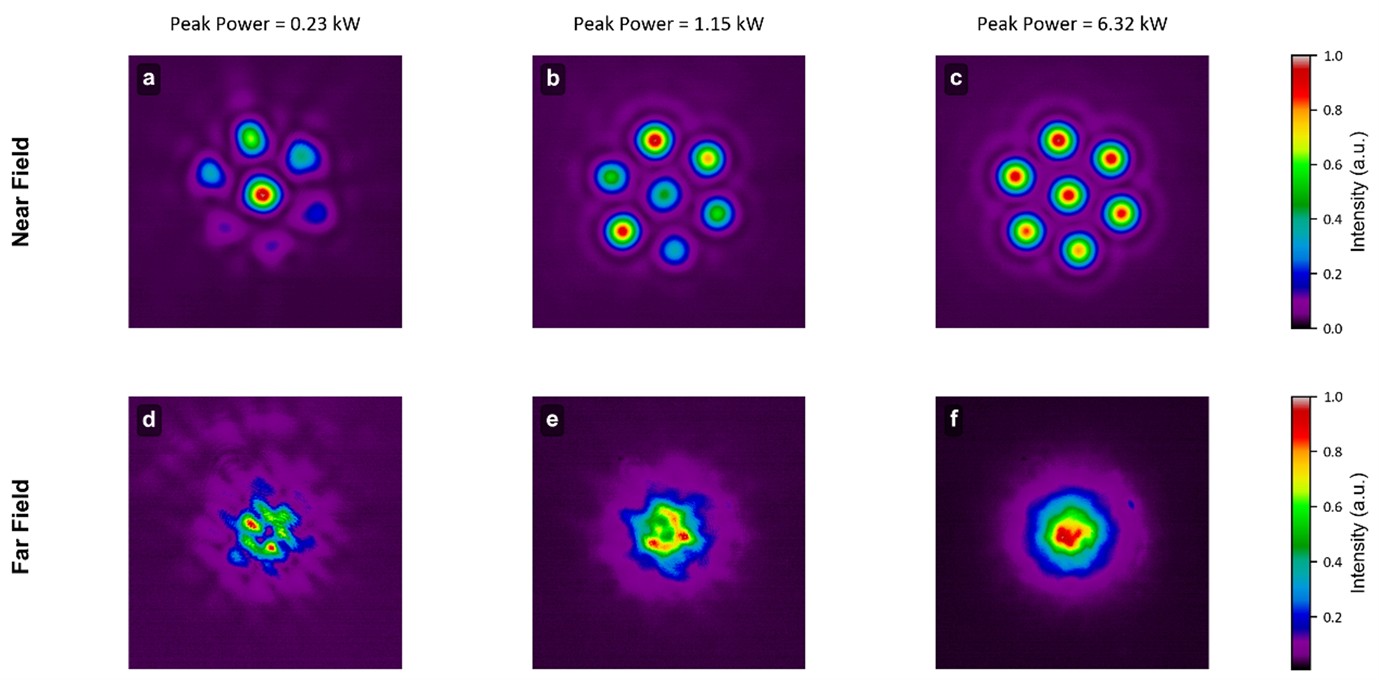
Near-field images of the fiber output (upper row) demonstrate spatial beam stirring, namely the formation of seven beams with nearly equal intensities as the peak power increases. Far-field images (lower row) show the corresponding transition from a speck
High-Power Pulses Bring Stable Light Equalization in Multicore Fiber
CHENGDU, CHINA, August 4, 2026 /EINPresswire.com/ -- In multicore optical fibers, a key research question was whether low-power and high-power laser pulses would distribute light differently among seven cores. Researchers from Russia found that low power gave random, unstable distribution, whereas higher power produced equal sharing across all cores and stability against bending and vibrations. The far-field pattern changed from speckled to bell-shaped. Modeling showed a statistical mechanism, where the pulse broke into many sub-pulses whose averaging produced stable equalization.Nowadays, cutting-edge scientific research is focused on finding new ways to transmit, control, and use light. Traditionally, optical fibers have been used in everything from telecommunication systems such as the Internet to medical equipment, because they provide low-loss light propagation over long distances. In recent years, researchers have also been exploring a new type of fiber that contains several light-carrying channels, called multicore fiber. This technology has the potential to improve how light is used in communication, imaging, sensing, and laser systems.
However, in the effort to make light transmission more efficient and reliable, a key question remained unaddressed: how would low-power and high-power laser pulses behave in a multicore fiber, and could the light be made to distribute more evenly and stably among the cores? At low power, light in such fibers was known to behave unpredictably, jumping between channels in an erratic and unstable manner. It was not clear whether increasing the power could change this behavior in a useful way.
This question was addressed by the research group of Prof. Sergey A. Babin from the Institute of Automation and Electrometry SB RAS and Novosibirsk State University, Russia, with post-doctoral researcher Dr. Alena Yu. Kolesnikova leading the study. To investigate how light behaves inside a seven-core multicore fiber, the researchers sent narrowband laser pulses into the central core and tracked how the output power was distributed among the individual channels under different input powers. They combined direct experiments with numerical modeling and analytical treatment to follow the evolution of the pulse along the fiber and to identify the physical origin of the observed beam stirring effect. The findings were made available online in Opto-Electronic Advances on June 21, 2026.
At low power, the light was found to propagate in a random and unstable manner, with strong fluctuations in the power carried by each core. As the input power increased, however, the behavior changed dramatically. The light began to distribute itself evenly among all seven cores, and the fluctuations were greatly reduced. The output beam also changed in character, shifting from a speckled and unstable far-field pattern to a smoother, bell-shaped profile. This equalization remained stable even when the fiber was exposed to disturbances such as bending and twisting, showing that the effect was not simply accidental, but robust.
As Prof. Babin noted, “the beam stirring effect shows that weakly coupled multicore fibers can self-organize under high-power excitation into a far more stable output state.” Dr. Kolesnikova added, “what is especially remarkable is that the pulse does not just spread randomly; its internal temporal structure helps average out the power exchange between cores.” The modeling showed that the effect has a statistical nature: at high power, the pulse breaks into many smaller sub-pulses, and their averaging over time leads to the stable equal distribution of light between the cores. In this way, nonlinear phase accumulation changes the direction of energy transfer along the pulse and makes the output progressively more uniform.
These findings are important for both fundamental science and practical applications. They suggest a new route toward more efficient high-power laser systems based on multicore fibers, where stable power sharing is essential. The work may also support future developments in light amplification, beam combining, imaging, and sensing technologies. More broadly, it expands the understanding of how light can be controlled in complex fiber structures and points to new ways of designing optical systems that are both powerful and resilient.
Reference
Title of original paper: Spatiotemporal beam stirring in a multicore fiber
Journal: Opto-Electronic Advances
DOI: https://doi.org/10.29026/oea.2026.260036
About Opto-Electronic Advances
Opto-Electronic Advances (OEA) is a premier, open-access journal dedicated to rapid, high-impact research in optics and photonics. Led by Editor-in-Chief Professor Xiangang Luo, it serves as a global platform for innovative research, boasting an Impact Factor of 22.4 and a CiteScore of 26.8. The journal's extensive scope covers fundamental and applied research in nanophotonics, plasmonics, metamaterials, and advanced optical materials. It also focuses on cutting-edge developments in light sources, sensors, optical imaging, and intelligent digital optics. Furthermore, OEA publishes significant work in biophotonics, nonlinear optics, ultrafast photonics, and photovoltaics. By publishing high-quality empirical and theoretical papers, OEA facilitates global knowledge sharing among researchers and professionals.
About Dr. Alena Yu. Kolesnikova from Novosibirsk State University, Russia
Dr. Alena Yu. Kolesnikova is a post-doctoral researcher and Chair of Quantum Optics at Novosibirsk State University, Russia. She has made the numerical model and performed the simulation in the recent publication “Spatiotemporal beam stirring in a multicore fiber.” Her other publications are in the fields of nonlinear fiber optics, multicore fiber dynamics, microresonator photonics, Kerr solitons, frequency comb generation, and optical sensing, with related work spanning both fiber-based photonic systems and nanoscale axial photonic microresonators.
Funding information
The work is supported by the Russian Science Foundation (grant 21-72-30024-Π) and the work of A.Yu.Kolesnikova on simulation – by the Ministry of Science and Higher Education of the Russian Federation (FSUS-2025-0010).
Siyi Ma
Institute of Optics and Electronics, Chinese Academy of Scie
+86 19136186296
oej_publishing@ioe.ac.cn
Legal Disclaimer:
EIN Presswire provides this news content "as is" without warranty of any kind. We do not accept any responsibility or liability for the accuracy, content, images, videos, licenses, completeness, legality, or reliability of the information contained in this article. If you have any complaints or copyright issues related to this article, kindly contact the author above.
